Improving focus and productivity is about controlling attention, energy, and decision load in a distraction-heavy environment. It requires aligning brain chemistry, work systems, habits, and environment to consistently produce high-quality output with less mental fatigue.
Key takeaways:
- Align 90-minute ultradian work cycles with 20-minute active breaks to match brain rhythms.
- Boost acetylcholine via single-tasking and dopamine through pre-task cardio for sharper attention.
- Use Cal Newport's time-blocking and shutdown rituals to minimize shallow work.
- Train prefrontal cortex with 10-minute daily mindfulness to rewire distraction resistance.
- Optimize nutrition-sleep-exercise triad: 7-9 hours sleep, omega-3s, 30-min walks for BDNF surge.
What Are Focus and Productivity?
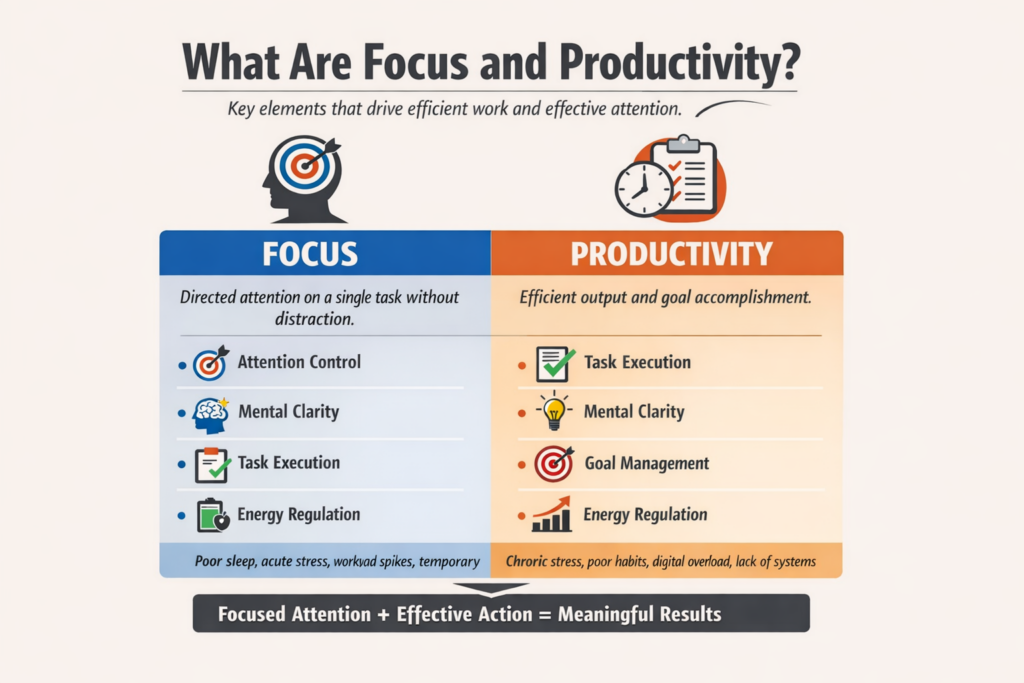
Focus is the ability to direct attention toward a single task without distraction, while productivity is the ability to produce meaningful output efficiently within a given time. Together, they determine how effectively a person works, learns, and solves problems. High productivity without focus often leads to shallow output, while focus without direction can result in wasted effort.
Core components of focus and productivity include:
- Attention control: The ability to stay engaged with one task while resisting interruptions
- Mental clarity: Reduced cognitive noise that allows faster thinking and better decisions
- Task execution: Translating intention into consistent action
- Energy regulation: Managing mental and physical energy to sustain performance
How to Improve Focus and Productivity (Step-by-Step)
Improving focus and productivity is a process, not a single habit. Real improvement happens when distractions are reduced, work is structured intentionally, and effort is directed toward meaningful output instead of constant activity. The steps below are designed to improve focus first and then convert that focus into sustainable productivity.
Step 1: Eliminate Distractions Before Optimizing Work
Many people try to improve productivity by adding tools or techniques while leaving distractions untouched. This approach fails because attention remains fragmented.
To improve focus effectively:
- Turn off all non-essential notifications on phone and computer
- Keep messaging apps closed during focused work periods
- Set clear “do not disturb” windows for deep work
Removing distractions immediately improves attention quality and reduces mental fatigue without adding extra effort.
Step 2: Define Clear Work Intentions Before Starting
Focus weakens when the brain does not know exactly what it is working toward. Vague tasks lead to procrastination and unnecessary task switching.
Before starting any work session:
- Clearly define the task in one sentence
- Decide what “finished” looks like
- Estimate how long the task should take
Clear intentions reduce hesitation and make it easier to stay focused until completion.
Step 3: Use Structured Focus Blocks Instead of Open-Ended Work
Open-ended work encourages frequent breaks, checking messages, and multitasking. Structured focus blocks create boundaries that protect attention.
Use focused work blocks of 60–90 minutes, followed by 5–15 minutes of rest. During each block:
- Work on one task only
- Avoid checking email, messages, or social media
- Stay with the task until the block ends
This structure allows deep focus without exhaustion and improves overall productivity across the day.
Step 4: Start With the Most Important Task First
Focus and willpower are strongest earlier in the day. Using this energy on low-value tasks reduces overall productivity.
To improve output:
- Identify 1–3 high-impact tasks each day
- Start with the most important task before anything else
- Delay minor tasks until after meaningful progress is made
Completing important work early creates momentum and reduces stress later in the day.
Step 5: Break Large Tasks Into Smaller Executable Actions
Large tasks feel overwhelming and often lead to avoidance. Focus improves when tasks are broken into clear, manageable actions.
Instead of working on a vague task:
- Break it into specific steps
- Focus on completing one step at a time
- Track progress through completion, not time spent
Small wins sustain attention and make productivity feel achievable.
Step 6: Reduce Task Switching and Multitasking
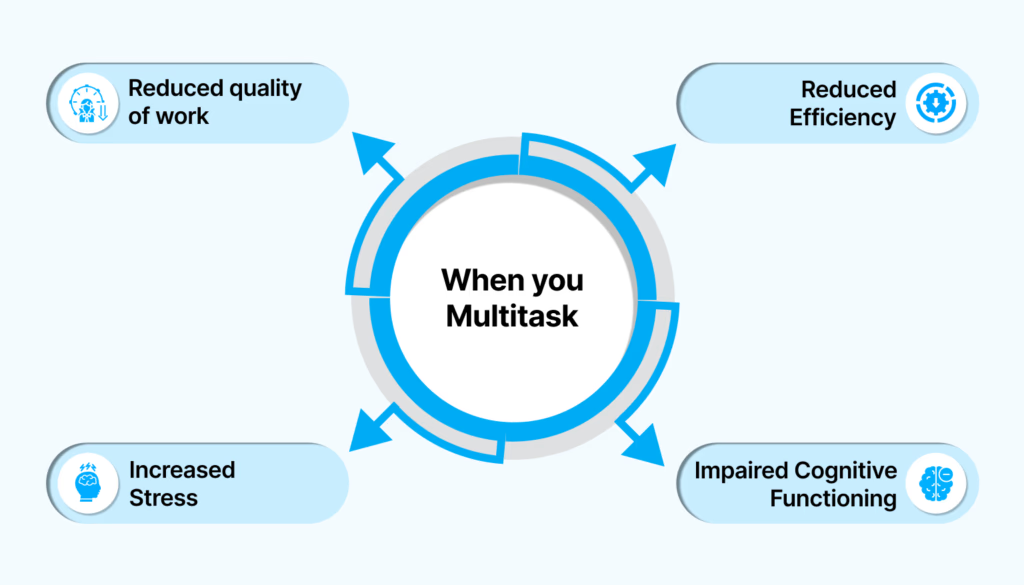
Multitasking reduces efficiency and increases mental fatigue. Focus improves when attention stays on one task until completion.
To reduce task switching:
- Finish one task before starting another
- Group similar tasks together
- Avoid switching between unrelated activities
Single-task execution leads to faster completion and higher-quality results.
Step 7: Manage Energy to Support Focus
Productivity depends on energy as much as time. Low energy makes focus unstable and work feel harder.
To maintain usable energy:
- Maintain consistent sleep and wake times
- Drink water regularly throughout the day
- Take short movement breaks between work sessions
Stable energy levels make sustained focus easier and reduce burnout risk.
Step 8: Design a Work Environment That Supports Focus
Your environment constantly influences attention. Clutter and noise quietly drain focus even when unnoticed.
Improve your workspace by:
- Keeping only essential items visible
- Reducing digital clutter on your screen
- Using a consistent location for focused work
A supportive environment reduces mental friction and improves concentration.
Step 9: Use Simple Planning Systems to Reduce Decision Fatigue
Repeated decisions throughout the day drain focus. Simple planning systems preserve attention for actual work.
Effective systems include:
- A short daily planning routine
- Fixed work start and end times
- A prioritized task list limited to essentials
When decisions are minimized, focus lasts longer.
Step 10: Build Consistent Routines Instead of Relying on Motivation
Motivation fluctuates. Systems and routines create consistent productivity regardless of mood.
Build routines such as:
- A fixed time for focused work each day
- A consistent order for completing tasks
- A shutdown ritual to end the workday
When focus is scheduled, productivity becomes predictable.
Key Factors That Affect Focus and Productivity
Focus and productivity are influenced by a few core, high-impact factors. Managing these areas produces the biggest improvements.
1. Sleep and Energy Levels
Insufficient sleep reduces attention span, slows thinking, and increases errors. Consistent sleep supports sustained productivity.
2. Digital Distractions and Task Switching
Frequent interruptions fragment attention and increase completion time. Reducing notifications and multitasking restores focus.
3. Poor Prioritization
Without clear priorities, effort is wasted on low-value tasks. High-impact task selection improves output without extra work.
4. Work Environment and Structure
Clutter, noise, and unstructured schedules increase distraction. Organized spaces and time-blocked work improve efficiency.
5. Inconsistent Routines
Lack of systems forces reliance on motivation. Simple routines protect focus and reduce decision fatigue
Can Focus and Productivity Be Improved?
Focus and productivity are highly adaptable skills. Improvements occur when attention is protected, energy is managed, and work systems are optimized. Small changes such as structured work sessions, distraction control, and clear prioritization produce measurable gains.
Consistent routines strengthen attention over time. Physical activity, adequate sleep, and proper nutrition enhance mental stamina. Productivity improves most when shallow work is reduced and deep, high-value tasks are prioritized. With deliberate practice and system design, focus becomes more stable and output quality increases sustainably.
Short-Term vs Long-Term Focus and Productivity Changes
Focus and productivity improvements can be experienced in both the short term and long term, but the nature and impact of these changes differ significantly. Short-term productivity gains are often driven by immediate actions such as eliminating distractions, using time-blocking techniques, drinking caffeine, or working under tight deadlines.
| Aspect | Short-Term Changes | Long-Term Changes |
| Primary cause | Lack of sleep, acute stress, temporary overload, distractions | Chronic sleep deprivation, sustained stress, poor habits, long-term digital overload |
| Onset speed | Sudden and noticeable within hours or days | Gradual development over months or years |
| Impact on focus | Reduced attention span and increased distractibility | Persistent difficulty sustaining focus and deep work |
| Impact on productivity | Slower task completion and more errors | Consistently lower output quality and efficiency |
| Cognitive fatigue | Temporary mental tiredness | Ongoing mental exhaustion and reduced cognitive endurance |
| Task switching ability | Momentarily impaired | Chronically inefficient with high context-switching cost |
| Reversibility | Easily reversible with rest and short-term adjustments | Requires lifestyle, system, and behavior changes |
| Effect on motivation | Short-term drop in drive | Long-term disengagement and burnout risk |
FAQs
1. How long can the brain realistically stay focused?
Most people can maintain deep focus for 60–90 minutes before performance begins to decline. After this point, attention weakens and errors increase. Short breaks allow focus to reset and help maintain productivity across longer work periods. Working beyond this limit without rest often reduces output quality.
2. Is multitasking harmful to productivity?
Yes. Multitasking forces frequent task switching, which slows completion time and increases mental fatigue. Although it feels productive, it reduces accuracy and focus depth. Completing one task at a time leads to faster, higher-quality results.
3. What is the fastest way to regain focus after distraction?
The fastest way to regain focus is to pause briefly, restate the task goal, and remove the source of distraction. Restart the task deliberately rather than rushing back in. This short reset prevents further attention loss and helps restore momentum.
4. Does dopamine affect focus?
Yes. Excessive stimulation from constant notifications, scrolling, or multitasking reduces the ability to sustain attention. When stimulation is reduced, focus becomes more stable and less effortful. Balanced stimulation supports consistent productivity.
5. Are productivity apps helpful?
Productivity apps are helpful only when they simplify work, not when they add extra steps. Tools that reduce planning time, organize tasks, or limit distractions support focus. Overusing apps can create more cognitive load and reduce productivity.
6. What time of day is best for deep work?
For most people, deep work is most effective in the mid-morning, when alertness and energy are naturally higher. However, the best time depends on individual routines. The key is scheduling focused work during your most consistent energy window.
7. How can I stay focused while working from home?
Create clear physical and digital boundaries between work and personal life. Use a dedicated workspace, fixed work hours, and scheduled breaks. Reducing household distractions and maintaining routine improves focus and productivity at home.
8. Does caffeine improve focus long-term?
Moderate caffeine use can improve alertness and concentration temporarily. Excessive use, however, disrupts sleep and reduces baseline focus over time. Consistent energy habits are more effective than relying heavily on caffeine.
9. How do I improve focus without burnout?
Focus improves when work is balanced with recovery. Use structured work sessions, take regular breaks, and avoid overloading your schedule. Prioritizing systems over constant intensity supports sustainable productivity without exhaustion.
10. Can focus and productivity be trained over time?
Yes. Focus and productivity improve gradually through consistent routines, better prioritization, and reduced distractions. Small daily improvements compound over time, leading to more reliable performance and higher-quality output.
11. Why do I feel busy but not productive?
Feeling busy often results from working on low-impact tasks and frequent interruptions. Productivity improves when attention is directed toward meaningful work. Clear priorities and focused execution reduce busywork and increase real progress.
12. What is the simplest way to improve productivity today?
The simplest way is to choose one important task, remove distractions, and work on it without interruption for a fixed time. Completing meaningful work creates momentum and improves focus for the rest of the day.
Conclusion
Improving focus and productivity is not about working harder or longer. It is about protecting attention, aligning work with cognitive energy, and eliminating systems that create constant distraction. Sustainable productivity comes from doing fewer things with greater clarity and intention. When focus is treated as a limited resource and work is designed around how the brain actually functions, output quality improves, burnout decreases, and progress becomes predictable rather than accidental.
References & Further Reading
Watson, N. F., Badr, M. S., Belenky, G., Bliwise, D. L., Buxton, O. M., Buysse, D., Dinges, D. F., Gangwisch, J., Grandner, M. A., Kushida, C., Malhotra, R. K., Martin, J. L., Patel, S. R., Quan, S. F., & Tasali, E. (2015). Recommended amount of sleep for a healthy adult: A joint consensus statement of the American Academy of Sleep Medicine and Sleep Research Society. Journal of Clinical Sleep Medicine, 11(6), 591–592. https://www.ncbi.nlm.nih.gov/pmc/articles/PMC4442216/
American Academy of Sleep Medicine. (2015, June 1). Seven or more hours of sleep per night: A health necessity for adults. https://aasm.org/seven-or-more-hours-of-sleep-per-night-a-health-necessity-for-adults/ .
Khan, M. A., & colleagues. (2023). The consequences of sleep deprivation on cognitive performance: A review. Frontiers in Sleep (Review). https://www.ncbi.nlm.nih.gov/pmc/articles/PMC10155483/ .
Killgore, W. D. S. (2010). Effects of sleep deprivation on cognition. Progress in Brain Research. https://pubmed.ncbi.nlm.nih.gov/21075236/ .
Ophir, E., Nass, C., & Wagner, A. D. (2009). Cognitive control in media multitaskers. Proceedings of the National Academy of Sciences, 106(37), 15583–15587. https://doi.org/10.1073/pnas.0903620106. (Full text/abstract).